


Great things happen in a work environment that allows growth. Creating a supportive environment, however, is largely in the leader’s hands. It would be wrong to think that only a leader’s shouting cripples results. In fact, much less is enough. What is psychological safety at work and how can it be achieved?
The concept of psychological safety comes up when we talk about a work environment where people dare to think out loud, ask uncomfortable questions and admit mistakes. It goes hand in hand with the belief that anything can be discussed openly in the team, without humiliation, rejection or fear of being punished. Amy Edmondson and Mark Bransby (2023) have stressed that psychological safety is not an abstract “soft value” but a measurable precondition, shaped by management practices, that is directly linked to learning, cooperation and performance.
Organisational culture can be understood along two axes: psychological safety and results orientation. Depending on how high the level of one or the other is, it is possible to determine in which direction the organisation is moving.
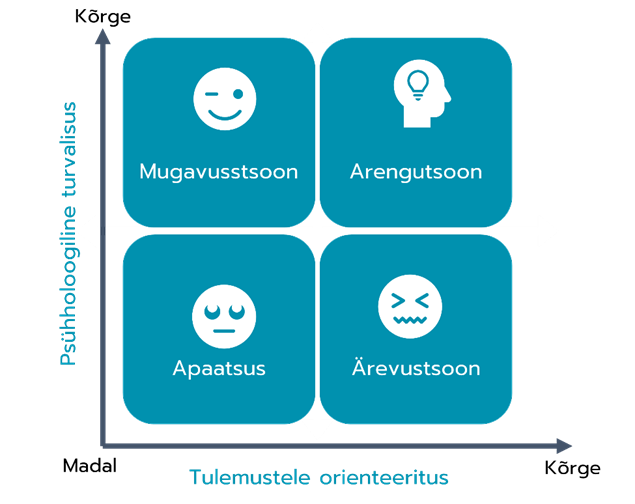
It goes without saying that a good leader wants to keep their organisation in the learning zone at all times. This is especially true in the public sector, where organisations shape policies, manage crises, lead reforms and provide services that affect society as a whole.
Estonia’s strength has long been its openness to innovation and the development of the digital state. We undoubtedly want innovation to continue. But innovation is not born in a culture of infallibility. It requires experimenting and sometimes learning from failure. When teams sense that, instead of systematic learning, the search for and blaming of a culprit begins even before the mistake itself, fewer risks are taken and development slows down. Not only the organisation loses out, but society as a whole.
So psychological safety is not just a wellbeing issue. It is the infrastructure of performance – an invisible but decisive foundation on which learning, innovation and responsible decision-making rest.
The question is not whether public sector organisations can afford to develop psychological safety, but rather whether they can afford its absence.
Am I on the right track?
The journey towards better psychological safety should start with the leader’s self-analysis. One of the key factors is body language. It is a very important part of organisational culture and carries significant micro-messages. Today, outright shouting or humiliation is rather rare, but micro-messages, often unconscious, carry exactly the same weight.
Psychological safety is usually not broken by one big scene, but by a series of small signals: a deep sigh at a question, rolling your eyes, demonstratively looking away, a smirk, burying yourself in your computer while another person is speaking, or an interruption in a tone that says: “You’re bothering me.”
These are low-intensity signals of disrespect, incivility, which undermine psychological safety. According to research, precisely these seemingly small discourtesies are widespread and linked both to a decline in employee wellbeing and to lower organisational effectiveness (Andersson & Pearson, 1999; Schilpzand et al., 2016).
A small gesture can set off a big chain: one eye roll silences the next question → because of the silenced question, a risk goes unnoticed → the risk grows into a problem.
Several studies of social exclusion have shown that even a brief experience of being ignored activates the same brain areas associated with physical pain, triggering a psychological signal of threat. When an employee repeatedly experiences that their contribution goes unnoticed or that their question is met coldly, with a sigh or similar, their willingness to speak up also decreases.
Ultimately, low psychological safety reduces learning and open information sharing and increases employee silence – a phenomenon described by the term employee silence (Edmondson & Bransby, 2023). Problems don’t disappear, they simply move into the shadows.
Empirical studies show that a low-safety environment affects not only employees but also leaders, steering them to make decisions that are safer from their own point of view, even if they are not optimal for the organisation. The result is apathy and systemic harm.
An organisation’s results don’t disappear with an explosion; it is rather a steady trend. People start to leave, but not because they are weak – because they have a choice, they dare to ask and they can spot risks.
What to do?
First of all, stop asking: “Is everyone OK with this?” It automatically produces silence.
Ask instead:
- What could go wrong with this plan?
- What am I as a leader not noticing?
- Who sees this differently?
- What are we assuming too optimistically?
Second, stop punishing the messenger. When an employee raises a problem and gets a defensive speech in return, you teach the whole room that next time it’s better to stay quiet.
Third, admit your own mistakes. A leader who never makes mistakes leads an organisation where no one else makes mistakes either — at least not openly.
Fourth, measure honestly. Ask anonymously whether people dare to express a different opinion. The answers may be uncomfortable, but cheaper than the price of silence.
Companies don’t need more slogans about openness. They need leaders who can bear an uncomfortable truth without defending their ego.
In the end, the company that loses is not the one where people argue too much. It is the one where important things are no longer talked about.

The cards are based on Shalom Schwartz’s theory of values, which focuses on how people’s values shape their attitudes and behaviour.
Get your own set of personal values cards here, or contact our development partner Monika Prits, creator of the cards, who also runs trainings on how to make the best use of these cards in your work.
Tool: Personal values
- Price €69 (incl. VAT)