


The moment you notice as a leader that your team isn’t achieving the results you want, you have two options. Either you work even longer days, believing that only more work will get you to the goal, or you take time out and analyse whether something needs to change in how the team works. If you chose the second option, put your phone on silent, close Outlook and read on.
One simple but very effective way of analysing how a team works is a retrospective meeting – a retro for short. Retrospective means looking back: in a retro, the team analyses its field of work and thinks about how to move forward better.
A retro makes it possible to analyse quickly and in a structured way what has worked well so far, what should change and which opportunities have not yet been fully used. This meeting format creates fertile ground for discussing how to solve challenges and cooperate even better in future. In essence, a retro gives you the chance to build self-improving teams that learn from their own experience.
A retro helps build self-improving teams
A retro is simple, effective and always leads to results, but that doesn’t mean leading a retro meeting is always easy. Skilfully led retros are extremely useful, but from an unskilfully run retro participants may get an unpleasant experience instead of the hoped-for benefit.
Those who have had some contact with such look-back meetings often ask how to run a retro so that it doesn’t feel like a waste of time and participants dare to share their thoughts openly. This is a common fear in organisations that aren’t used to giving and receiving feedback and discussing together how we could work better together, grow as a team and, in the process, improve our motivation and performance.
So that you can get the most out of a retro, let’s look more closely at what the value of a retro is, who it is for and in which situations it rather doesn’t fit.
Why a retro, or what is the value of a retro?
Teams need time and a place to analyse their work, find opportunities to grow and get better. Often a lot of emphasis is put on WHAT we do, but too little on HOW we did it. A retro helps do that.
The biggest advantages of a retro:
- A retro gives the chance to hear the opinion of all team members in a way that the opinions of more active participants don’t overshadow those of the more reserved.
- In a retro, problems are brought to the table neutrally, and owners, concrete solutions and deadlines are found for them together.
- The team jointly agrees on concrete actions to be carried out in the near future to achieve better motivation and performance.
Who is a retro for and how often?
Every team that wants to develop continuously uses retro meetings in one format or another – they just may not call them that. That makes it all the more important that these meetings are well structured and consciously run.
Structured look-back meetings should take place regularly: for example after every sprint, project, month or quarter. But this regularity doesn’t have to be time-based (e.g. every two or four weeks). Rather, we recommend holding a retro according to what the company’s rhythm of life requires: after a project, at the end of a sales or trade fair season, after a team’s launch period and so on.
We recommend holding a retro according to the company’s rhythm of life
The retro format is also suitable for analysing the team when problems have arisen. For example, a project has failed, an unexpected situation or change has caused confusion, the desired result wasn’t achieved during the sales season, the division of roles in the team isn’t working or the energy level is somehow low.
The retro card set includes ten retros with different structures, each with sample questions. The set even includes retros for topics that are otherwise hard to talk about, for example for analysing different events, expressing gratitude and raising hidden problems neutrally.
In which situation does a retro not work?
When running a retro, the participants’ mindset is very important: “Regardless of what we discover in the retro, we believe that everyone did the best job they could.” If all participants can keep an open mind, the retro runs smoothly and delivers the desired results.
The main pitfalls of a retro:
- In a situation of little trust and a closed atmosphere, it can happen that people don’t dare to name the real problems and talk about trivia instead.
- When the meeting isn’t consciously led – the topic of the retro isn’t clearly defined, people don’t listen to each other and interrupt.
- When the retro looks for a culprit rather than a solution – with painful problems, people start venting and blaming each other indirectly or even directly.
- The focus is directed outside “our” area of responsibility.
In short, most of the problems that can arise in a retro meeting come down to how conscious the person running the meeting is. A well-prepared leader who steers the process firmly can avoid these dangers.
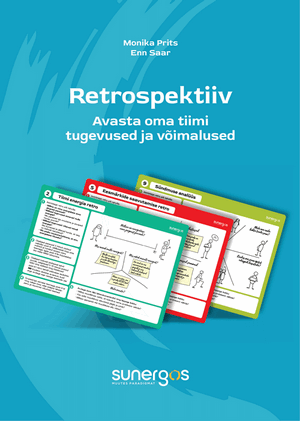
If the topic interested you and you would like to know more, take a closer look at our retro card set or contact our development partner Monika Prits, creator of the retro cards, who also trains retro facilitators.
Retrospective Toolbox
- 10 guides for running team retros
- Price €49 (incl. VAT)