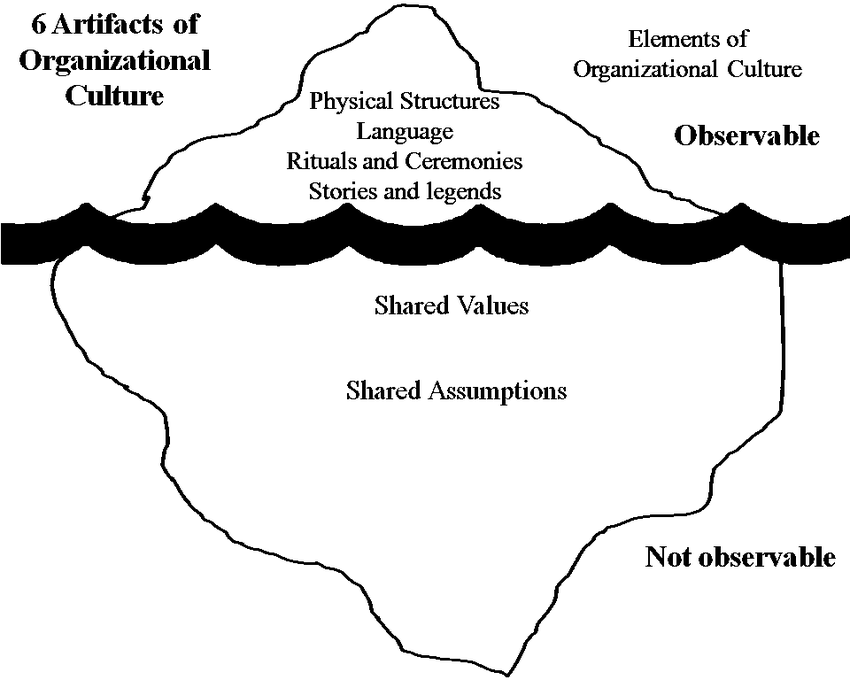


In January I wrote at length about what organisational culture is and what elements it consists of. According to E. T. Hall’s Cultural Iceberg model, the elements fall into two groups – visible and observable parts, such as goals and strategy, processes, management structure, rituals and ceremonies, sign systems, behaviours and stories; and invisible, hard-to-observe elements, such as mission and purpose, roles, norms, attitudes and ethics, values, beliefs and assumptions.
Even before starting to consciously change the elements of culture in an organisation, you need to start from 2 postulates and make sure 4 important prerequisites are met. Most organisations creating culture focus on the first three elements of culture: goals and strategy, processes and management structure. Agreement is reached on the desired culture (e.g. the organisation’s values), but this isn’t followed by those elements of culture coming to life and surviving in the organisation. For a culture change to truly succeed, two important postulates must be taken into account when developing organisational culture:
1. Every organisation has a culture at every moment
When creating culture, you must always take into account that every group already has some elements of culture that make up that group’s culture. This fact is often forgotten when creating culture. The desired elements of culture may clash with the group’s existing elements of culture. For example: an organisation decides that one of the group’s important values is taking responsibility. At the same time, the organisation’s management structure has strict decision-making limits and authorisations that don’t give people the right to decide independently. A conflict arises between the new and the existing element of culture.
2. Elements of culture are not absolute in an organisation
No element of culture can ever be absolute in an organisation. It is difficult, if not impossible, to reach a situation where all the organisation’s employees understand its values in exactly the same way and act on them in exactly the same way too. Nor is it sensible or necessary to introduce all elements of culture in exactly the same way in all of the organisation’s teams (e.g. ceremonies). The ways in which the organisation’s teams carry out one element of culture or another in their team could be left for them to decide.
Prerequisites for creating culture
Creating or changing elements of culture requires the group members’ wish and will to change their attitudes, behaviour and so on, based on what matters from the point of view of the organisation’s culture. Such changes can only happen under the following prerequisites.
1. A united group of leaders with a concrete vision Creating culture in an organisation requires clearly distinguishable leaders who share a common mission and purpose for the organisation. The leaders are also role models in carrying the elements of the organisation’s culture, i.e. the leaders’ deeds match their words and the elements of the organisation’s culture. In organisations, leading culture development is often left to the HR department, while the organisation’s leaders don’t consistently focus on the elements of the culture change in their own behaviour. The result is mixed signals for people in the organisation, which leads to the realisation some time later that the desired culture change hasn’t happened.
2. An environment that favours change For people’s behaviour, attitudes and mindsets to change, an environment must be created that lays the ground for personal change to succeed. When implementing changes, organisations mostly forget what the individual’s needs are for the change to be received positively by them. The basic needs that must be met beforehand from the point of view of every group member are: – being accepted by the other members of the group; – trust and openness in the group.
The SCARF model (Dr David Rock, 2012), based on brain research, describes five factors that must be met for our will as individuals to be and act in a group to be high. In essence, these five factors can be seen as every employee’s five obstacles or enablers in adopting any change.
3. The skill and will to give feedback and feedforward on changes in elements of culture consistently and often The third prerequisite, without which culture can’t take root in a group, is the organisation members’ skill and will to give each other feedback every day. Every change requires more energy and effort from the individual than repeating the existing situation or pattern of behaviour. That is why a large share of culture changes fail: people don’t get daily confirmation or reminders, as so-called micro-messages, of how they are doing with the changes in the elements of the organisation’s culture. A negative example is agreeing on and introducing organisational values. Agreeing on values ends at the point where the values have been agreed and, in some cases, discussed and debated with all employees. After that, the marketing department makes posters for all the meeting rooms, and that is where the work with values ends. The steps described are necessary, but not sufficient.
Principles for consciously creating culture
For a culture change to succeed and last, the following principles must be followed through all the steps of managing the change:
1. Every desired change in culture must be supported by the other elements of culture All elements of culture must be coherent and supported by the other elements of culture. For every important decision concerning the organisation’s culture, decisions must be made RIGHT AWAY on how to support this change with the other elements of culture every day. Example: an organisation chooses openness as an important value. Next, it needs to ask, for example, the following questions and also make changes in other elements of culture:
| Element of culture | What questions to ask and what to change? |
| Rituals and ceremonies | How can we contribute to greater openness in teams’ everyday work? Which ceremonies should be added to everyday meetings (e.g. an opening round and sharing personal stories/feelings/experiences etc. at the end of the meeting)? |
2. Connecting the change with every employee’s personal level The likelihood of the change succeeding is greater when the organisation’s members can connect with the desired change in an element of culture through personal stories and needs.
3. Consistent attention and uncompromising demandingness Creating every element of culture, and culture as a whole, requires consistency and demandingness in what has been agreed or decided. When creating culture, it is important to be uncompromisingly demanding and consistent in keeping the agreed elements of culture constantly in focus. Every concession on an agreed element of culture sends a micro-message to the people in the organisation: “This probably isn’t important after all.” Example: the team has agreed that in meetings where we are together, we are always there for each other. If one of the team members buries themselves in their computer during a team meeting and no one points it out, it sends all team members the micro-message: “Being there for each other is not an important norm to follow.” The moment the team or organisation gets the message that a given element of culture isn’t important right now, the culture starts to change in a direction other than the one agreed.
Uncompromising demandingness in creating culture means noticing an undesired situation RIGHT AWAY, sharing it with each other and, if possible, changing it immediately.
Consistency means constantly bringing the agreed elements of culture to the fore.
4. Trusting relationships that make it possible to create and pass on elements of culture Culture is created through social relationships. Physical and audiovisual sign systems only support culture, but can never create culture on their own. Example: organisations that want to increase cooperation and openness by creating an open-plan office. Without working with the other elements of culture, however, such attempts always fail.
Creating culture in an organisation requires visible leaders who share a common mission and purpose for the organisation. The leaders are also role models in carrying the elements of the organisation’s culture, i.e. the leaders’ deeds match their words and the elements of the organisation’s culture.
Changing organisational culture is a long-term process that needs constant attention – support from the other elements of culture, employees’ personal connection and uncompromising demandingness. At the same time, when developing culture, you need to keep an eye on which elements describe the current culture and how it relates to the desired culture.
In the third article on consciously creating culture, I will share my vision of how to consciously create the desired elements of culture and why creating culture can fail.