

“We’re going to update our strategy in the first quarter!” You hear calls like this in the meeting rooms of many organisations in the last months of the year. For many of us, the word “strategy” is associated with long and tiring discussions that result in a hefty document that is then forgotten for years.
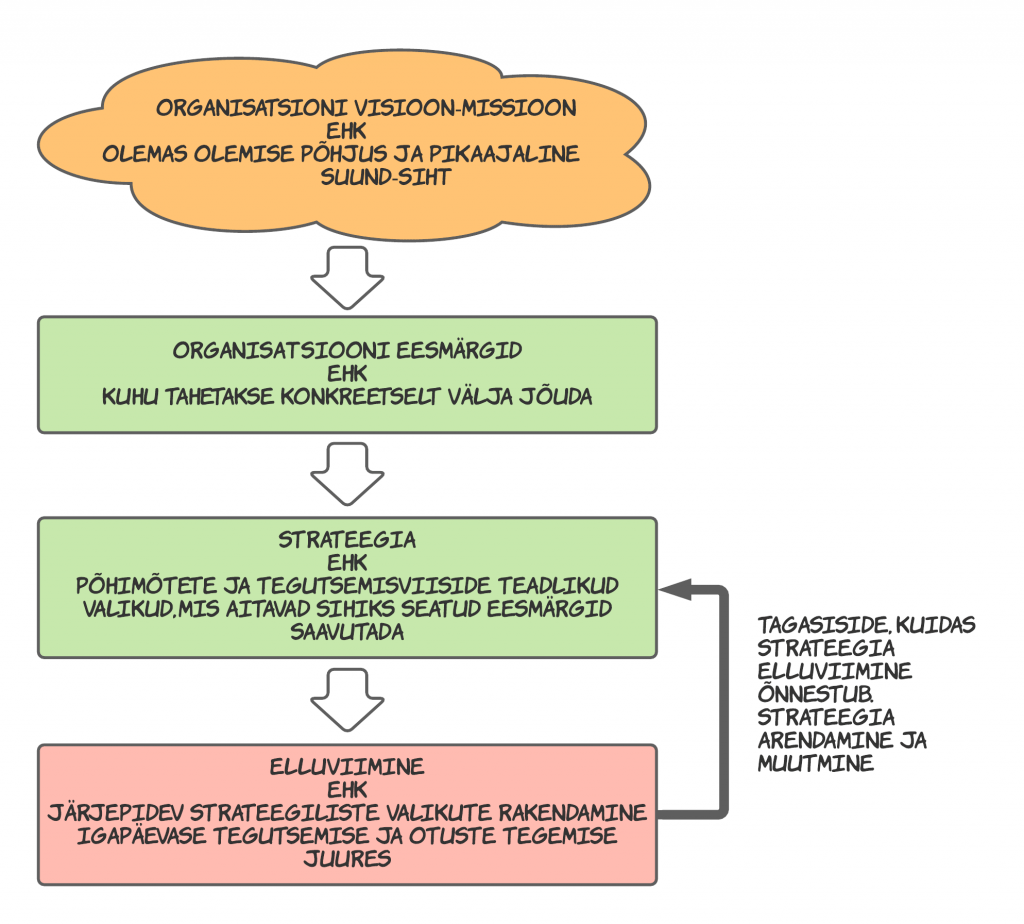
A strategy is a selection of HIGH-IMPACT activities, behaviours and principles that we have chosen because we believe they will help us achieve the desired goal.
What we as an organisation do not do, i.e. what we resolutely say no to, can be just as important as what we do and how. A strategy is not an end in itself; it answers the question:
“WHAT ARE OUR MOST IMPORTANT CHOICES THAT HELP US ACHIEVE OUR GOAL?”
Why has strategy become a dirty word in organisations, standing for corporate bureaucracy? Here I point out 5 reefs that people run aground on when creating strategies. These reefs are based on my work and experience as a leader and team trainer.
THE FIRST REEF: Strategy is a book of all the company’s activities and principles.
Writing down all the choices and principles makes strategy discussions drag on and boring. People want to write into the strategy every principle and process that exists in the organisation. And on top of that, every idea of what could be done differently in different areas.
In my work, I have unfortunately also come across situations where strategy has become a tool for some leaders to justify the existence of their unit and why the existing principles of operation must not change.
HOW TO AVOID THE FIRST REEF?
Less is more! Focus on making and putting crystal clear the MOST IMPORTANT choices for achieving your organisation’s goals (the 80:20 principle, if you like). Make sure everyone understands what a given strategic choice means in everyday work.
Every principle can be valuable to some extent, but some principles have a greater impact on achieving the goal than others.
THE SECOND REEF: Strategies that say nothing
The emptiest strategies are those with sentences like: “We offer our customers the best value for money”, “We are innovative in developing our products” and so on. People understand such slogans in completely different ways, which means they also act differently. Slogan-like and vague strategies are useless, i.e. creating such strategies is time thrown away. How can you tell whether a strategy is empty? There are 2 tests:
- The mirror test – ask your team members what the organisation’s most important operating principles are for achieving its goals. If the answers are all over the place, there is usually no thought-through, sharp strategy either.
- The juggling test – if you notice that in your organisation every next topic brought to the table is the most important, then most likely your days are filled with the feeling that you are constantly putting out fires. All this signals a missing or empty strategy.
HOW TO AVOID THE SECOND REEF?
Allow and encourage passionate debates on strategic choices, where everyone is allowed to challenge parts of the strategy. For example: “It’s unclear to me what we mean in the strategy by the sentence: the customer is king. I suggest we write out more concretely how we want the customer to feel with us, or what exactly we do or don’t do in customer service.”
Throw all slogans and catchphrases out of the strategy if they are understood and interpreted differently and can’t be used as a basis for giving each other recognition and feedforward in everyday work. The more concrete and emotionally binding your strategic choice is, the easier it is to remember and carry out in everyday work.
Illustrate strategic choices with examples and stories that clearly show what the strategy looks like in everyday work. Stories bind people emotionally to the strategy.
THE THIRD REEF: Wanting to make all strategic decisions at once.
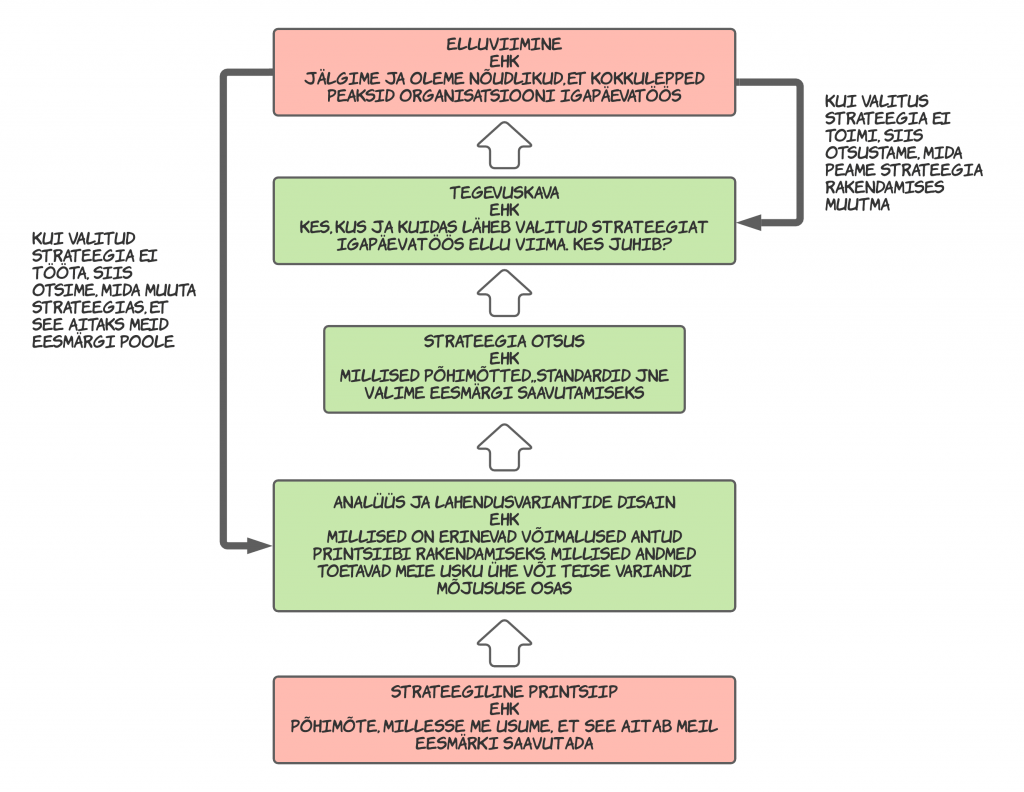
Reviewing strategy cyclically (once a year or once every couple of years) is a thing of the past. Strategic, i.e. the most important, choices must be in front of the team all the time. Strategy must change when the facts show that the current strategy isn’t working, i.e. isn’t leading to the goals. In essence, this means that the organisation constantly monitors whether the chosen strategy is working or not.
Not all important choices can be made within the time frame of cyclical strategy-making. Refining some strategies takes longer, because the data for the decision is missing or the strategic choices are incomplete.
It is naive to think that every year there comes one magical moment when all the organisation’s important strategies are clearly agreed. At any moment, an organisation’s strategies are at different stages – there are those that work and lead us towards the goal, there are strategies where we are still looking for which choice to make, and so on.
HOW TO AVOID THE THIRD REEF?
Break your organisation’s strategy down into smaller strategies. Choose the MOST IMPORTANT strategies that help you as an organisation achieve your goals. For each important choice, regularly (at least twice a month) check the status of that strategy. For each IMPORTANT CHOICE, agree on:
- who drives this strategy
- what stage the strategy is at (e.g. we are still putting the strategy into words or drawing up an action plan)
- what the measurable 2-week goal is for this strategy
THE FOURTH REEF: We let emotions drive decisions
How are strategic decisions made? On gut feeling? On data and validated hypotheses? As people, we let emotions influence a large part of our choices. The same happens when making strategic choices. The most common trap is basing strategic choices on the events of the last couple of weeks and interpreting those events as an unstoppable trend.
For example, as leaders we tend to assume that all our company’s potential customers think, behave and make their decisions exactly like me and my friends. Or we overemphasise the feedback of two emotional customers on the deliveries of the last few weeks, without analysing whether these customers’ cases are the organisation’s most important weak points in the quality of its services and products, or isolated cases that happened to cluster in the last few weeks.
I don’t want to diminish the importance of dealing with every customer contact here. What matters is making sure we don’t make premature strategic choices about what to deal with and what not on the basis of cases that happened to cluster together.
HOW TO AVOID THE FOURTH REEF?
For each strategic option, ask the team: what data confirms our choice, and what data casts doubt on the correctness of our strategic choice? If you have worked systematically on the quality of your services, you certainly have a data-based overview of the most important root problems related to quality.
Challenge your team on whether the data used is reliable and sufficient.
THE FIFTH REEF: We loosen the reins and aren’t demanding
Once a strategic decision has been made, the tension in the team drops. Phew, the decision is finally made. But now the important part only begins. A strategy without everyday execution is a pile of paper that doesn’t bring us any closer to the goal as it is.
It is sad to hear leaders’ summarising sentences at the end of teams’ strategy days: “Oh, how could we make sure that the clarity and concreteness we have created don’t fall apart in everyday work?”
The death of a strategy is lazy leaders who don’t want or dare to be demanding about its execution. A strategy that is looked at once every six months or every quarter is a dead strategy.
If something is extremely important for achieving your organisation’s goals, it must get attention every day.
HOW TO AVOID THE FIFTH REEF?
A strategy lives in an organisation when the strategic goals, directions and choices are in front of the team and in its focus every day. The most effective way to achieve this is good old consistent routine and being demanding.
Strategic goals and directions must be the most important topics at the beginning and end of every meeting. We get what we measure and pay attention to.
These five reefs are connected. The reins are loosened when strategic choices are vague and unclear. Strategic choices are unclear when we have made decisions purely on the basis of emotions. We make decisions in a hurry when there are many things on the table and we don’t take time to ask ourselves what is MOST IMPORTANT for achieving the desired result.