


Pirjo Künnapuu, Social Insurance Board, head of family benefits
In recent years there have been significant changes in how public sector organisations are managed: the traditional hierarchical organisational model is increasingly being replaced by service-based management. In this story, the Social Insurance Board (SKA) shares its experience on this journey, where the change was supported by Sunergos service-based management consultant and coach Enn Saar.
One of the main prerequisites for moving to service-based management is a clear understanding of what change we want to achieve. We also need to understand why this change is needed – in other words, what problem we are solving. The transition can only succeed if we understand what we are going to change and why.
As moving to service-based management brings changes across the whole organisation (work organisation, new roles, retraining and so on), the process requires thorough planning and broad involvement and communication. In institutions that have introduced service-based management, the transition is usually organised in stages over several years. To implement the change, a person responsible is appointed at management level, whose task is to ensure a smooth transition and the effective functioning of the organisation.
At SKA, we began moving to service-based management with the family benefits system. But before we talk about the steps we took on this journey, let’s first look at what family benefits are.
Family benefits are cash benefits paid through SKA that increase the wellbeing and quality of life of children and families and thereby encourage births. Every month, about 175,000 people in Estonia receive family benefits; counted separately by type of benefit, there are 344,938 recipients in total. The annual family benefits budget is approximately 937 million euros.
Family benefits policy is coordinated by the Ministry of Social Affairs and implemented by SKA as the implementing agency. Family benefit services are generally proactive, i.e. offered on the basis of entitlement using data known to the state. So to receive a benefit, a person doesn’t need to do anything other than review the offer and confirm it.
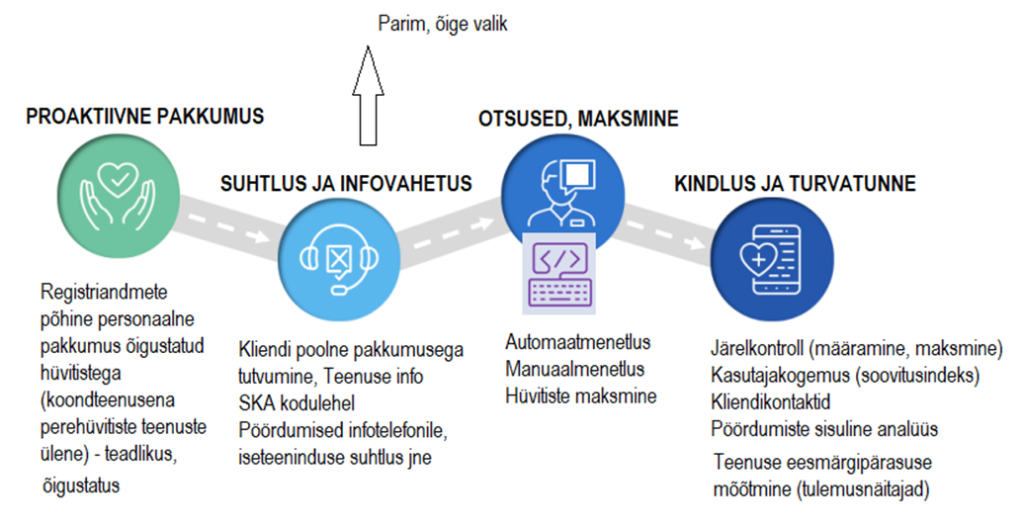
Our first goal was to understand whether the current design of the service is exactly what today’s parent and the board’s employees need and expect. When providing our services, can we ensure confidence, security and efficiency? All stakeholder groups have their own expectations of the service, and our goal is to meet them.
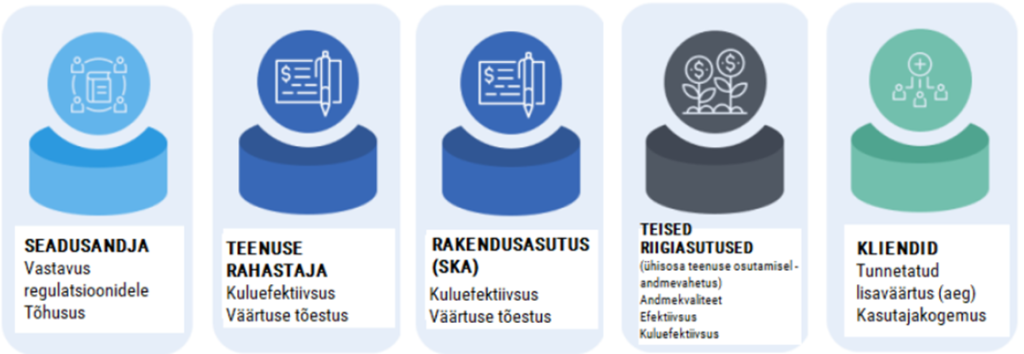
To find out how well we can meet customers’ expectations, we have to measure our services. We wanted to know whether our services serve their purpose, deliver results and create satisfaction – and metrics are the indicators that tell us this.
For example:
- In the family benefits service, our customer is a young parent – for them, a service that creates value is one that saves time. A suitable metric here is the recommendation index: the family benefits services have a recommendation index of 71%, with the time saved being mentioned most.
- Our customers also include other state institutions, for example the Health Insurance Fund. For their service – sickness and care benefits – to be provided on time and in the right amount, the family benefits service has to transmit data on time and correctly; this is the Health Insurance Fund’s quality metric for us. Here SKA can measure its service by looking at how much data we have exchanged with the Health Insurance Fund, whether the data has been of good quality and, if there have been glitches, how quickly and in what way we resolved them.
What matters is that, as a service, we know and understand the content of our services and their impact on the different parties, and can notice and point this out at these important touchpoints.
Next, we looked more closely at the goals of the service, because their precise wording and unambiguity lay the foundation on which to build the service. Putting the goals into words was one of the most difficult stages in moving family benefits to service-based management. The metrics, i.e. the criteria that show whether the service is goal-driven, were not that hard to write down, but it was hard to put the goals into words clearly enough to convey their meaning unambiguously within SKA, to external partners, to the ministry and to the people of Estonia.
When setting the goals, it was clear that they must stem from family policy but support the particularities of our service and tell us whether we are moving purposefully and as expected in the right direction. If it had turned out that we weren’t, the goals would have helped us find out – then we could have planned the necessary improvements proactively.
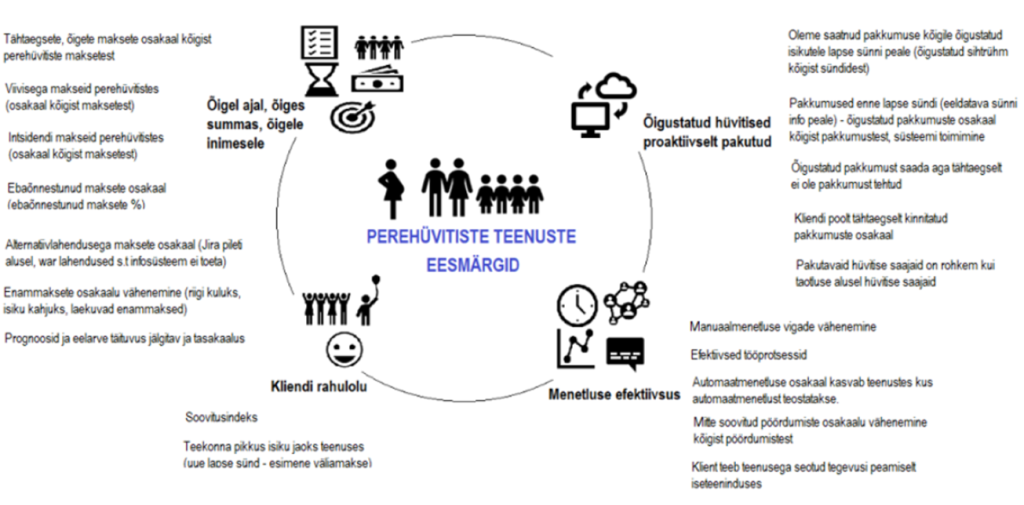
Guided by these ideas, we finally wrote down four main goals:
- At the right time, in the right amount, to the right person
- Customer satisfaction
- Entitled benefits offered proactively
- Efficiency of processing
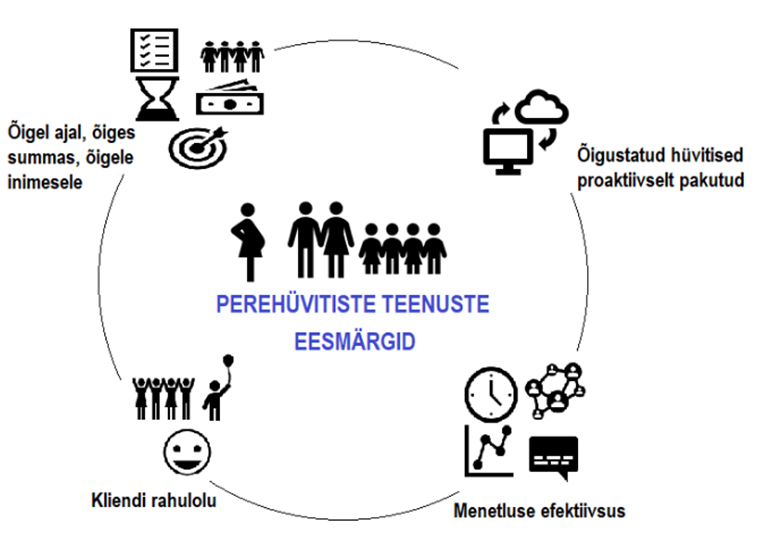
Now that the goals were in place, we had to look at how to measure their achievement. To do this, we first looked at the service’s existing data – to find out what we already measure. Once that was done and the current level known, we started putting specific metrics into words.
In total we had nineteen metrics for the four goals. Here is one example:
- Goal – efficiency of processing
- Metric – efficient work processes
The efficiency of work processes is a metric that requires substantive work, because it shows quality. So in the work process we had to analyse not so much WHAT is done, but WHY and HOW it is done. As a result of mapping the work process, we marked duplicated activities and activities that don’t add value and are rather administrative in nature.
For example, control queries were always sent to everyone, so 24 case handlers each spent about 2 minutes opening and filtering the query only to find out that there was nothing to process because the list was for another official’s area. Having discovered this, we changed the query conditions so that the query is only sent to the officials whose customers made the queries. In total, we gained 48 minutes of extra time from the service’s point of view! And we also eliminated the officials’ feeling that they have to deal with unnecessary things.
Now that the goal and metric of the services are written down, ahead of us is the role of the service’s resources in achieving the goal, and how their everyday activity is reflected in the metric, through which we can state and show each team member’s contribution to achieving the goals.
This is a big job, but a very valuable one worth investing in, because it helps every employee see their role and value in the service. I see one of the most important values of service-based management precisely in this: every link that contributes to the service does so in a very structured, purposeful and thought-through way, i.e. in line with the goal. Why? Because when every link connects its activity to the goal and measures it through the metric, it already ensures efficiency and effectiveness.
In short, metrics are like a muscle that needs consistent daily work: they constantly need adjusting, monitoring and changing. Even when the metrics have been adjusted to perfection, they must be maintained with great care and passion, following a fixed routine.
Today, now that we know the service’s resource use, the share of recommending and non-recommending customers, the quality of service provision, customer satisfaction with the service, the efficiency of the payment process and so on, it is much easier for us to make development decisions and propose changes to legislation.
Now we really know what we are talking about: behind our words is numerical proof, not gut feeling.
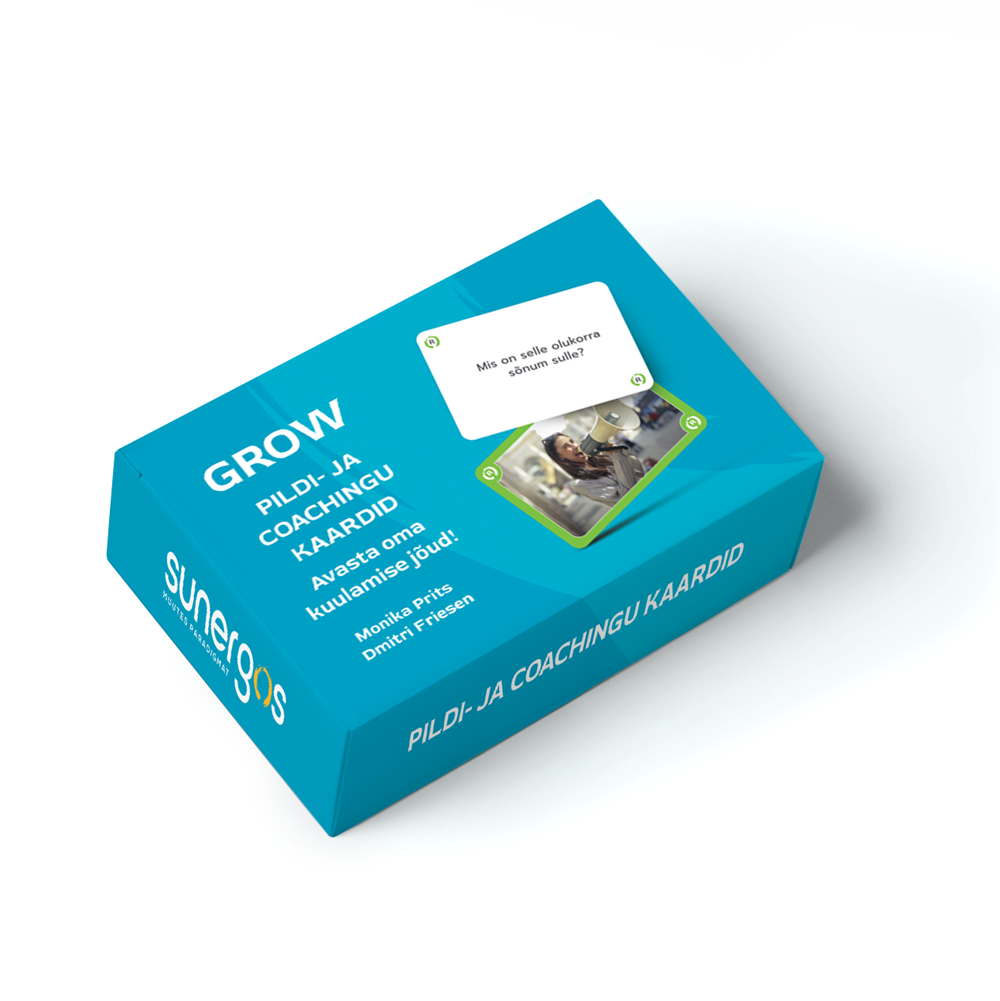
The GROW model is a simple and effective coaching framework used in conversations, meetings and everyday leadership, both face to face and in online meetings. Get your own set of GROW picture and coaching cards here, or contact our development partner Monika Prits, creator of the cards, who also runs trainings on how to make the best use of these cards in your work.
GROW picture and coaching cards
- Price €69 (incl. VAT)